Rediscover the New Taste of Tradition
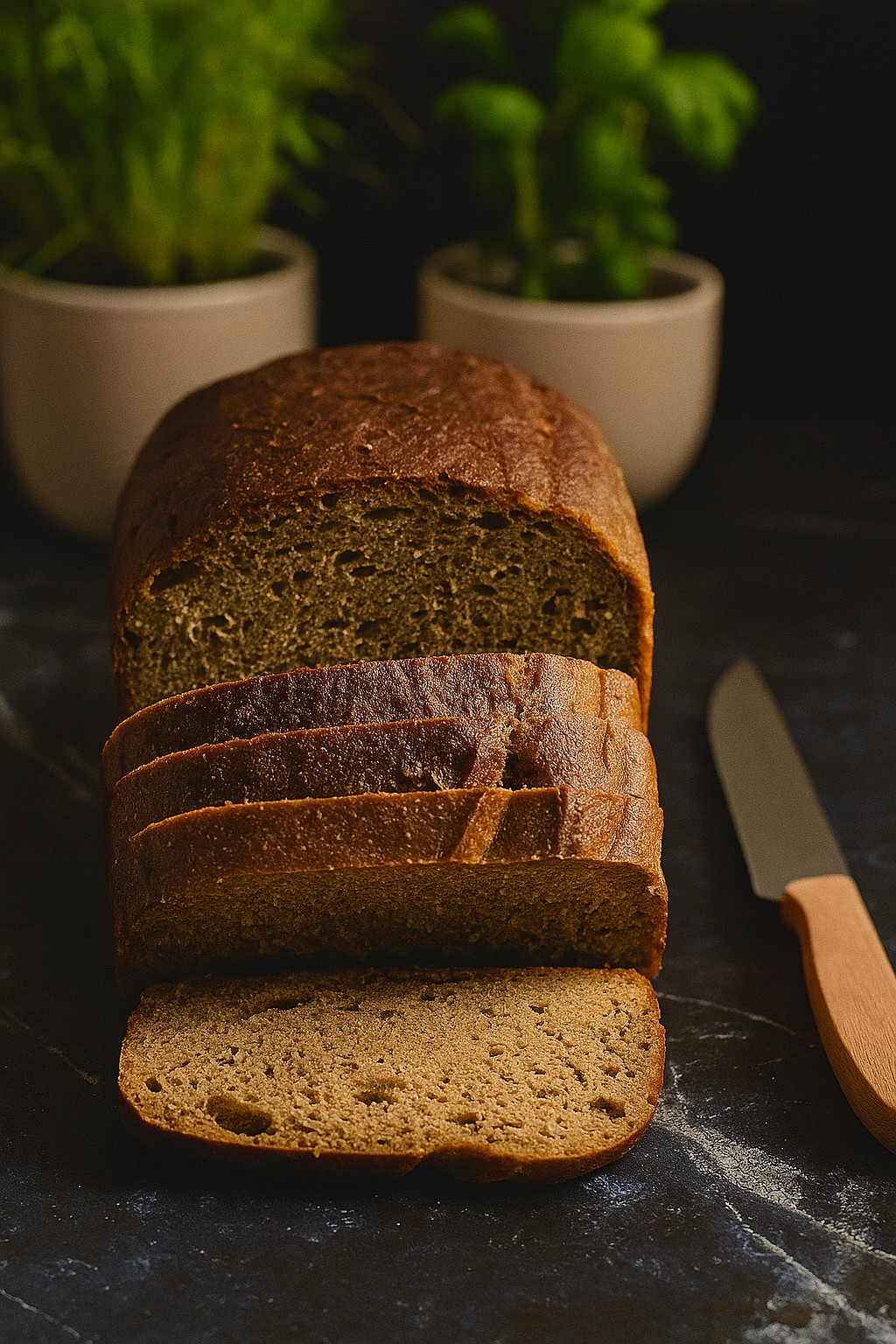
Authentic Rye-Style GF Sourdough Bread
Tested in real home kitchens | Structured method | Adaptable for vegan diets | No special equipment required
Experience the rich, deep flavors of my Gluten-Free Rye-Style Sourdough Bread Formula. Recreate the taste many of us grew up with — even if you have to bake gluten-free. This formula was developed out of personal need and refined through careful ingredient selection, fermentation control and structural testing. It gives you a dark, aromatic loaf with the depth and chew of traditional rye — adapted for gluten-free baking.
See my dark sourdough in action here.
The Real Craving
For many with celiac disease or gluten sensitivity, the longing for the hearty, complex taste of real rye bread is a constant companion. The absence of this staple can feel like a loss of cultural heritage, leaving a void that supermarket alternatives fail to fill. The desire for a slice of home, rich in tradition and flavor, remains unmet.
More Than Appearance
A true rye-style GF loaf aims to reflect
• taste
• color
• acidity
• and even aroma
of traditional fermented rye-bread. That combination is difficult to achieve without rye — but not impossible.
Not Just for Me
When this formula finally worked, I realized something simple:
I wasn’t the only one missing real rye bread. So instead of keeping it to myself, I chose to document the process clearly and share it — so others wouldn’t have to start from zero. If you’ve been searching for the same taste, this is for you.
Choosing Your Edition
Free
Creating GF Sourdough- Detailed instructions about creating GF sourdough
- Basic Bread Recipe
Artisan Collection
Enhanced Baking Experience- Everything in the Essential Formula
- Extended knowledge of ingredients and hydration achieving different breads:
- Traditional Pan Loaf
- Free-Form Mini Bread
- Seeded Variation
Essential Formula
Reliable Foundation- Base fermentation method
- Ingredient framework
- Rustic artisanal loaf
- Light artisanal variation
- Printable formula sheets
* All materials are licensed for personal use only.
Common Questions
If you don’t find your question answered here, you’re welcome to contact me before purchasing. I personally review all inquiries and aim to respond within 2–3 working days.
I’m always happy to respond to respectful inquiries related to the formula and purchasing process. Please note that individual taste and expectations vary, and I’m not able to assume responsibility for personal preferences.
Is this formula suitable for beginners?
Yes, our formula is designed to be accessible for all skill levels, with detailed instructions to guide you through each step. But you must consider that creating sourdough bread is time consuming and needs your attention and dedication. Creating one loaf may take alltogether from feeding your starter to ready made bread about 24 to 36 hours. Take this process as journey of creating something with you own hands what is so rear and admirable these days.
Are the ingredients complicated?
This is not a “three-ingredient” shortcut recipe. The ingredient list may appear more detailed than in a typical gluten-free recipe — and that is intentional.
Each component is selected for a specific functional purpose:
to support structure, elasticity, moisture balance, color, aroma and sliceability. Nothing is included without reason.
Gluten-free baking does not rely on a single flour to carry the entire structure. Instead, it requires a balanced combination of ingredients that work together to create depth, stability and consistency.
While the formulas are structured and precise, they are not unnecessarily complicated. You will learn how each ingredient contributes to the final result — and once understood, the process becomes clear and repeatable.
While some ingredients may not always be available in every local grocery store, they are widely accessible through online retailers.
Are the recipes given in grams or cups?
All recipes are written in grams. Weight-based measurements are standard in European baking and provide the precision needed for reliable gluten-free results. Small changes in hydration or flour ratios can alter the outcome, so accuracy matters. If you’re used to baking with cups, you can convert the measurements using common online tools. But once you try baking by weight, you may find it simpler and more consistent.
Do I need special equipment?
No special equipment is required to begin. You do need an oven — but beyond that, standard kitchen tools are enough.
The artisan-style loaf holds its shape well and can be baked directly on a regular baking tray. The pan loaf version can be baked in a standard loaf tin.
As your skills develop — and if you choose to refine your process further — you may eventually wish to use tools such as a banneton, a Dutch oven for covered baking, or a bread lame instead of a sharp knife. These tools can enhance certain details, but they are not necessary when starting out.
At the beginning, ordinary kitchen equipment is entirely sufficient.
Can I substitute ingredients?
While we recommend following the formula for best results, we provide tips for substitutions where possible. We still can`t guarantee the best result if substitutions are used or some ingredients are left out. Where possible, we have left you free choice whether to use or not use the ingredients. Anyway, you are welcome to build your own recipe if desired, development on different versions of rye-style breads are highly recommended.
How long does the bread stay fresh?
Depending bread type, it might stay fresh up to 5-7 days when stored properly. Higher hydration bread typically stays longer than dark artisanal loaf. For food safety we do recommend to store your bread in paper bag in freezer starting from day three from baking and consume it within 3-5 days although it can be completely palatable after that as well. You may want to toast your bread from next day of baking or especially when keeping it in freezer.
I`ve never eaten traditional rye bread. What if I dont`t like rye-style GF bread?
Taste is always personal. Flavor is subjective.
Traditional fermented rye bread has a distinct character — it is denser, slightly sour and more structured than typical white loaves. If you are used to soft, neutral-flavoured bread, our rye-style GF bread may feel very different at first. That said, many people who have not grown up with dark bread tradition discover that they appreciate its depth and complexity once they experience it freshly baked. If you are curious and open to exploring a more structured, fermented flavour profile, this may be a rewarding experience.
Do you offer a money-back guarantee?
This product is a digital download. Due to the nature of digital content, all sales are final and non-refundable. By completing your purchase, you acknowledge that you receive immediate access to the digital materials and therefore waive your 14-day right of withdrawal in accordance with EU consumer protection regulations.
Please review the product description carefully before purchasing. If you have any questions about the content or suitability, feel free to contact us prior to completing your order.
Ingredient & Dietary Considerations
Vegan Adaptability
The formulas are not exclusively vegan by default, as some recipes may include ingredients such as whey protein or honey.
However, vegan adaptations are possible. Whey protein can typically be replaced with suitable plant-based alternatives such as rice or soy protein, and honey can be substituted with sugar or molasses.
As gluten-free baking relies on structural balance, substitutions may slightly influence texture or flavour. Guidance is provided where appropriate to help you adjust thoughtfully.
On Sustainability
The formulas are primarily plant-based and built on wholegrain flours, fibre-rich ingredients and naturally fermented processes.
Most core ingredients are agricultural crops that are widely cultivated across Europe and commonly transported through established supply chains.
Animal-derived ingredients, such as honey or whey protein, are used only in specific recipes and can be replaced with plant-based alternatives where preferred.
The intention behind these formulas is diversity of crops and minimal reliance on highly processed blends.
Allergies & Subsitutions
While all formulas are gluten-free, some recipes may include optional ingredients such as whey protein, honey or small amounts of baker’s yeast.
Where relevant, alternative options are indicated. For example, whey protein can typically be replaced with plant-based protein sources such as rice or soy protein. Honey can be substituted with sugar or molasses. Recipes that suggest a small amount of yeast can generally be adapted, depending on preference and experience.
These formulas are designed with flexibility in mind, but they are not medical or allergy-specific products.
On Nutrition and Ingredient Quality
Many gluten-free breads rely heavily on refined starches and white flours to mimic softness. In contrast, my formulas prioritize wholegrain flours and fibre-rich components as the structural foundation of the bread. The aim is not only texture, but also depth and substance. Several recipes include naturally protein-rich ingredients, and some incorporate whey protein to further support structure and nutritional balance. While this is not a “health product,” the ingredient choices reflect a preference for fibre, protein and whole-food components rather than starch-heavy blends.

Stop Adjusting. Start Baking.
Gluten-free sourdough often becomes a cycle of small corrections — more water, less starch, different flour, another attempt.
This formula brings those variables into balance. So instead of troubleshooting every loaf, you can focus on baking it well.
Transform your GF baking with our Gluten-Free Rye-Style Sourdough Bread Formula.